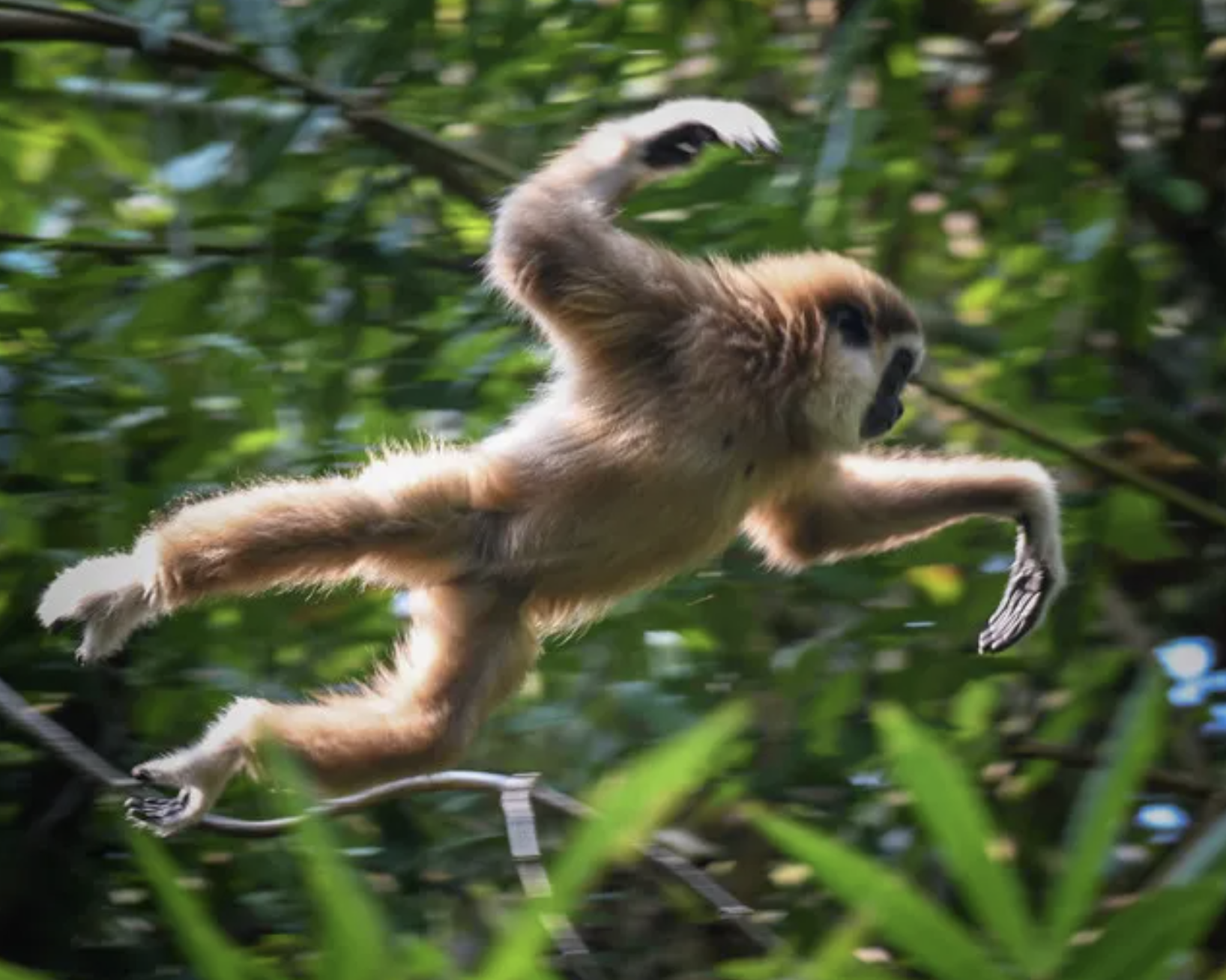
We are on a huge mission to return Thailand’s most intelligent wildlife species, gibbon, back to where it was previously poached to extinction.
เกี่ยวกับ
About Gibbon Gibbons are classified in the Kingdom Animalia, Phylum Chordata, Subphylum Vertebrata, Class Mammalia, Order Primates, Superfamily Hominoidea and Family Hylobatidae. Gibbons are small, arboreal apes distributed in the wild in the tropical and subtropical rainforests of Southeast Asia. They are currently found in small populations in Thailand, China, Laos, Vietnam, Cambodia, Bangladesh, NE India, Myanmar, Malaysia, and Indonesia. Most countries consider them to be endangered, and they are threatened primarily by the demands grey tourism industry and loss of their forest habitat. Other factors contributing to their demise include the illegal wildlife trade, the use of their body parts in the manufacture of traditional medicines, and poaching for meat. Gibbons have long fascinated scientists and lay people because of their agility in the forest tree tops. Gibbons are excellent brachiates (arm-swingers), and this is one reason they make popular zoo exhibits. In the wild, gibbons live in nuclear families consisting of a mated pair and their dependent offspring. The family unit occupies a territory, and they defend its boundaries by a vigorous vocal and visual display. The vocal display consists of a spectacular, bird-like duet between the mated pair, with the young occasionally joining in. This vocalisation, or song, is audible for long distances and are one of the primary way our team (and poachers) locating wild populations. This haunting melody has become part of the folklore of the indigenous people of Southeast Asia. In Thailand, local even crown gibbons as “Queen of the forest”. Gibbon in the wild There are 21 living gibbon species, whose coloration range from cream to brown, gray and black. In some species the males and females have a sex-specific coloration. The color of infants of some species is different from the adults. The 12 species are categorized in 4 genera: Nomascus, Symphalangus, Hoolock, and Hylobates. One unique aspect of gibbon physiology is that the wrist is composed of a ball and socket joint, allowing for biaxial movement. This greatly reduces the amount of energy needed in the upper arm and torso, while also reducing stress on the shoulder joint. They also have long hands and feet, with a deep cleft between the first and second digits of their hands. Their fur is usually black, gray, or brownish, often with white markings on hands, feet, and face. Some species have an enlarged throat sac, which inflates and serves as a resonating chamber when the animals call. This structure is enormous in a few species, equalling the size of the animal’s head. Gibbon skulls resemble those of great apes, with very short rostra, enlarged brain-cases, and large orbits that face forward. Gibbons have the typical nose of catarrhine primates with nostrils that are close together and face forward and slightly downward. They lack cheek pouches and their stomach is not sacculated. Their teeth also are similar to the great apes, with molars that are bunodont and lack lophs. The upper molars usually have a cingulum, which is sometimes large. The canines are prominent but not sexually dimorphic. Where do gibbons live? Native to the dwindling rain forests of South and Southeast Asia, gibbons are arboreal and considered to be among the world’s greatest acrobats. They have the ability to swing from tree to tree distances of 50 feet, at speeds of up to 35 mph, while in trees 200 feet above the ground. This mode of locomotion–swinging under branches while suspended by their hands is called brachiating. Gibbons are one of the few monogamous primates, and whether on the ground or in the trees, they are known for their dexterity and ability to walk upright. Often referred to as the “songbirds” of the primate family and the most musical land mammal, gibbons can project their voices up to 2 miles through the dense rainforest canopy. Unfortunately, their natural habitat is being destroyed at the alarming rate of 32 acres per minute! Gibbons live in the tropical and less seasonal rain forests of South and Southeast Asia, from the northeastern tip of India to southern China, across Bangladesh and the Malaysian peninsula to Borneo, Java, and Sumatra, including the Mentawai Islands. All gibbon species live allopathically, with the exception of the Siamang (S. syndactylus), which occurs sympatrically with white-handed gibbons (H. lar) in northern Sumatra and agile gibbons (H. agilis) on southern Sumatra and the Malaysian mainland. A few small natural hybrid zones exist in Thailand. How we begin In an early 1980’s, a six-month-old baby gibbon was rescued in Bangkok by a group of kind-hearted individuals, after being found chained to a pole, exposed to harsh weather conditions and on the brink of death. Although the group tried to care for her, their limited knowledge and the lack of available veterinary clinics at the time unfortunately led to her passing. Despite the heartbreak of their loss, the group’s passion to help wildlife continued to burn bright. With the cooperation of the Royal Forest Department (at a time when the Department of National Parks, Wildlife and Plants Conservation had not yet been established in Thailand), the group continued to rescue more gibbons and other wild animals such as tigers, bears, leopard cats and pangolins. They providing them with care by their own resources and funding in their own backyards. As word of their efforts spread, the number of rescued gibbons grew rapidly, reaching over 70 individuals. Each one was given the care and attention needed to thrive and recover from their past trauma. In 1992, when the first action law regarding wildlife was established, the group made the decision to formalize their efforts and establish the Wild Animal Rescue Foundation of Thailand (WARF). With a strong mission to save Thailand’s wildlife, the organization continued its work to rescue and care for gibbons and other wild animals, helping to give them a second chance at life. Around the same time, the situation for the gibbon population in Phuket had become seriously critical. Gibbons were being taken from the wild and used in the tourism industry, as there was great demand from international tourists wanting to see, play with, pet, and take photos with a species they do not have in their own countries. Unfortunately, this led to no gibbons being found alive in their natural habitat, and the future of the species in the area looked uncertain. With the launch of the new wildlife law, the chief of the Royal Forestry Department in Phuket found himself facing a challenging situation. A growing number of gibbons were being confiscated and needed care, and despite his best efforts, he and his team were struggling to keep up. They sought assistance from the Asian Wildlife Fund, and together, they contacted the Wild Animal Rescue Foundation of Thailand (WARF) for support. With their most extensive experience in working with gibbons at the time, WARF was able to step in and establish the Gibbon Rehabilitation Project (GRP) and assigned T.D. Morin as the first manager to find a solution for the gibbons to be released back into the wild. His efforts served as an inspiration for many to really start paying attention to the gibbon situation in and around Phuket. Gibbons previously under the care of WARF in Bangkok, who successfully passed all required blood tests, were transferred to GRP. For those who did not pass the test, WARF and the Royal Forestry Department collaborated to establish the first Wild Animal Rescue Center in the country, where these gibbons were relocated. With the growing number of gibbons at GRP, a team of experts and volunteers from around the world was invited to join the project, aiming to provide optimal care, rehabilitation, and, ultimately, release of the gibbons into their natural habitat in Phuket. Over the first ten years of its existence, GRP released a number of gibbons into five isolated islands around Phuket, utilizing various methods and relying on extensive studies by numerous experts, researchers and volunteers. Despite their best efforts, however, none of the gibbons were able to successfully adapt to life back in the wild after having spent their lives in captivity as cruelly kept pets. After years of setbacks, GRP developed a new plan to move the gibbons back to Phuket’s last remaining rainforest. With dedication and hard work, the team finally achieved a major breakthrough when they successfully released the first gibbon family back into their natural habitat. Over time, through trial and error, the team at GRP refined their techniques, and as a result, the gibbon population reached a point where they could begin to repopulate on their own. Major media in the country even headlined that the previously extinct gibbon had finally returned to Phuket. Today, the release efforts have expanded to the north of Thailand, where gibbons have also faced extinction due to poaching. The team has made many new breakthroughs in releasing more gibbon families in much shorter periods. The project has seen great success in reintroducing captive gibbons back into the wild, contributing to the protection and preservation of these precious apes for future generations.
สนับสนุน
ทุกการบริจาคช่วยให้ The Gibbon Rehabilitation Project ดำเนินงานในชุมชนต่อไป เงินของคุณไปถึงพวกเขาโดยตรง HappyToVolunteer ไม่รับหรือดำเนินการเงินแทน
Bank transfer
 Bank of Ayudhya (Krungsri)
, Pa Khlock, Phuket Branch. SWIFT: AYUDTHBK. Suggested amount: 100 THB (approx. 3 USD) can feed 1 gibbon a day. 4000 THB (approx. 120 USD) can feed all gibbons in our care a day (including supplements). We are tirelessly working towards the goal of preserving and protecting these gibbons. Every contribution counts and is crucial to helping us provide for the gibbons under our care and to continue pursuing our objective of reintroducing them to the wild. https://www.gibbonproject.org/product/donate-to-help-us-save-gibbons/
Gibbon reintroduction remains a relatively novel aspect of the conservation movement, as well as unexplored territory for researchers worldwide. At the Gibbon Reintroduction Project (GRP), we have spent over 30 years experimenting with various methods of reintroducing gibbons into the wild. Each reintroduction offers a chance to learn, as every gibbon comes from a unique and often heartbreaking background. Our groundbreaking discoveries from fieldwork provide us with invaluable lessons that contribute to the future rehabilitation and release of these lovely species.
One of the most effective ways to combat the illegal use of gibbons is to eliminate demand, both for the illicit tourism industry and the pet trade. By educating visitors at our Center for Conservation Education and Fund-Raising, the GRP aims to raise awareness about the challenges faced by captive gibbons and the role tourism plays in the demand for baby gibbons.
Our goal is to repopulate the last remaining rainforest in Phuket-Khao Pra Theaw Non-Hunting Area (Department of National Park, Wildlife, and Plant Conservation). Gibbons were hunted to extinction in Phuket over 40 years ago. We also aim to reintroduce gibbons to our second release site in the far north of Thailand, Pang Champee, where gibbons have been absent for decades.
ความน่าเชื่อถือ
ข้อมูลที่ช่วยให้คุณมั่นใจในองค์กรนี้
มีเลขทะเบียนองค์กรไม่แสวงหากำไรหรือการกุศลอย่างเป็นทางการ
ของขวัญที่มีคุณสมบัติอาจขอลดหย่อนภาษีได้ตามกฎท้องถิ่น